Civilization have pondered stars throughout time. Their light has both evaded and enticed our attentions. At first we believed the stars to be magical objects worthy of our idolizing. They were put up there by our gods and they deserved our tribute. Then our view of the heaven evolved due to the observations of Tycho Brahe, Galileo Galilei, and the Herschels. They revealed a field of stars moving with almost sparkling delight. But they showed their distance in cold space. These observations led to the idea of stars possibly being objects that were either super planets and or gaseous objects. Further observations led to second hypothesis being verified. Now this set the stage on the examinations of stellar evolution. How do stars come alive and live their lives?
Scientific Questions
Recently my class studied the Curtis-Shapley Debates and scientific issues questions in this debate. As follow-up they created videos that brought up scientific issues of their own. Click here for the YouTube playlist. The issues presented were human cloning, Large Hadron Collider, fossil fuels, evolution, and commercial fishing. Our opinions on the winner of Curtis-Shapley debate are here.
Curves in the Path…
After the Curtis-Shapley Debates, the macro universe had been defined as a grouping of island universes. The island universes, or galaxies, were constructed of stars. And among those stars were the Sun and its planets. And diving down into these planets, we find ourselves on Earth, which contained an active ecosystem constructed of land, air, and life all interconnected to each other. That was the picture around the time of these debates. But other observations were being made, observations that indicated a micro world underneath all matter. The observations were of particles making sinuous trails in the clouds; light being dispersed in component colors; and electronic jumps caused by light shining on metal. This suggested a world of components, of quanta. And this made all the difference in our world view; that the small affects the large. After reading “Quantum Behavior” in Six Easy Pieces (R. Feynman; 1995; Helix Books, pgs. 115 – 138); comment on the world view before and after the development of quantum theory.
At the Observatory Part II…
We had more fun at the Buehler Observatory. Students came to the observatory from different classes: AST 1002, AST 1004 and AST 1022L. On Tuesday (1/31/2012) night we had a limited night as rain invaded the observatory pad. We did observe the Moon and two planets: Jupiter and Venus. People seemed to enjoy their views of these objects. And it seemed on Wednesday (2/1/201) for a time that we would have a repeat of rain; but the clouds parted and we were able to observe for a longer time. Here is a collection of images from both myself and the students. The images were exposed using a FujiFilm Finepix J20 unless otherwise indicated.
These images were all obtained on 2/1/2012. Both the Moon and Venus were in the gibbous phase. And both Mars and Venus were close to the horizon thus the problem with seeing. We had fun and if you attended any of the sessions and have observations, please post them in the comments of either post. Thank you in advance for your posts.
At the Observatory
Last two nights (1/18 and 1/30) were nights for exploration and magic at the Buehler Observatory at Broward College. We observed the Moon, Jupiter, Venus, M42, and several double stars over the last two nights. The weather held for most of the two nights; the clouds did make a quick appearance at one point each night.
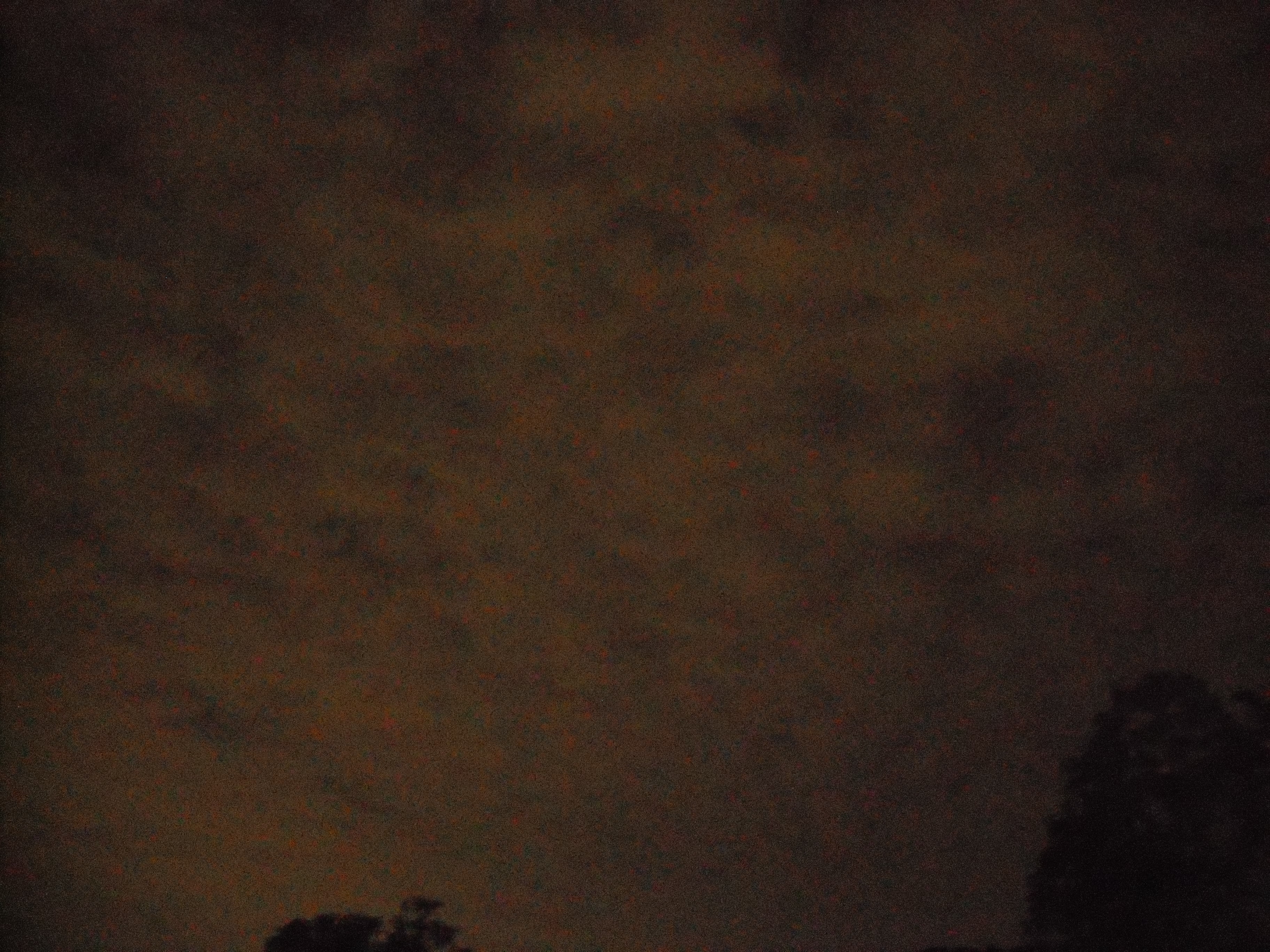
The clouds come rolling in at the end our night.
Here is a picture of Venus taken from a Meade LX-200 12 inch with a FujiFilm Finepix J20. It was beautiful image and showed the gibbous phase. This observation was made on 1/18/2012.
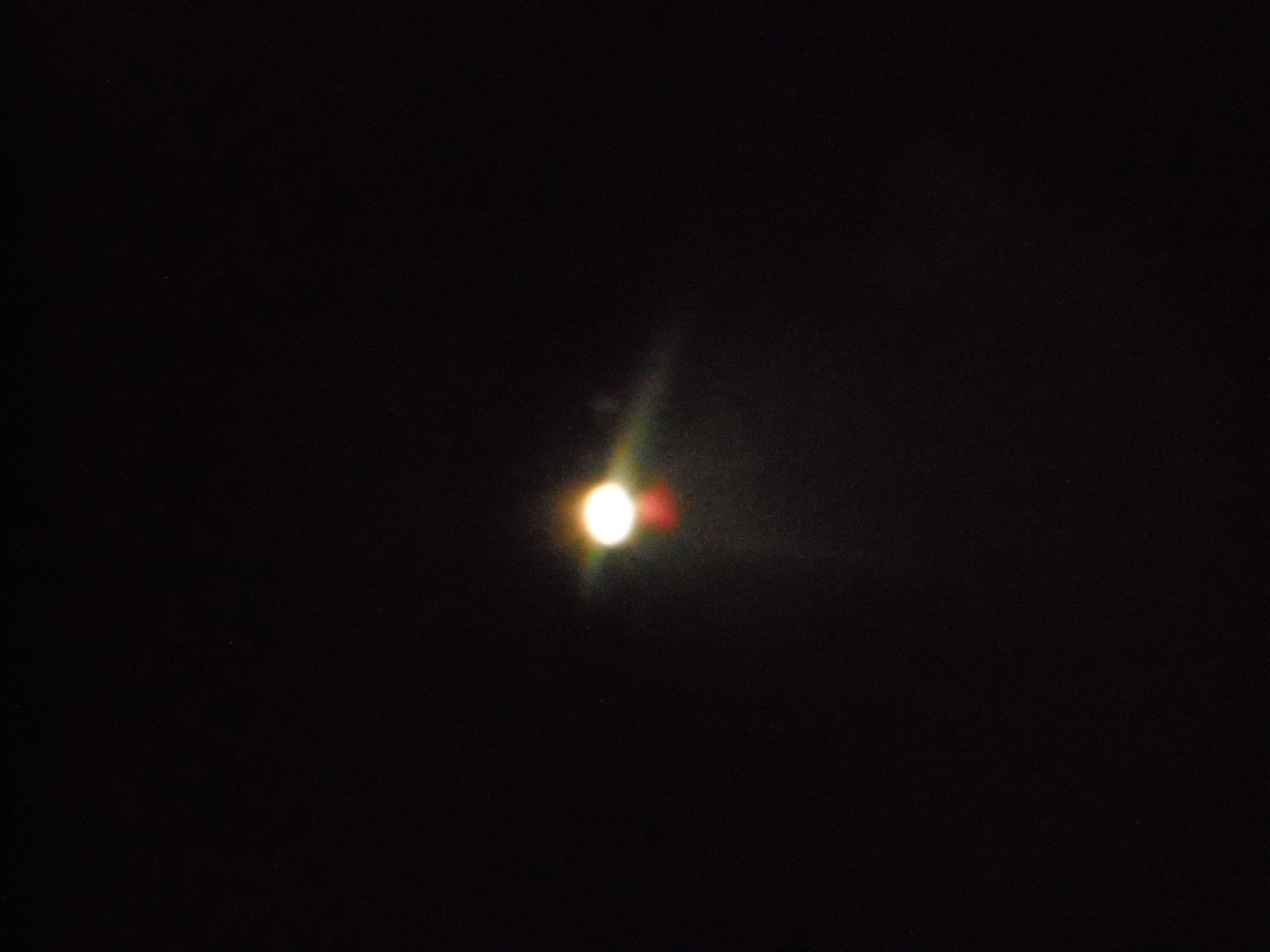
Venus from the LX-200.
We observed Jupiter with the LX-200 12 inch with the same camera. One view is of the planet itself and the other view is of the moons around the planet. You can see the rings in the planet and the Red Spot had just transitioned behind the limb of the planet. These observations were made on the 1/30/2012.

Jupiter and Moons the LX-200
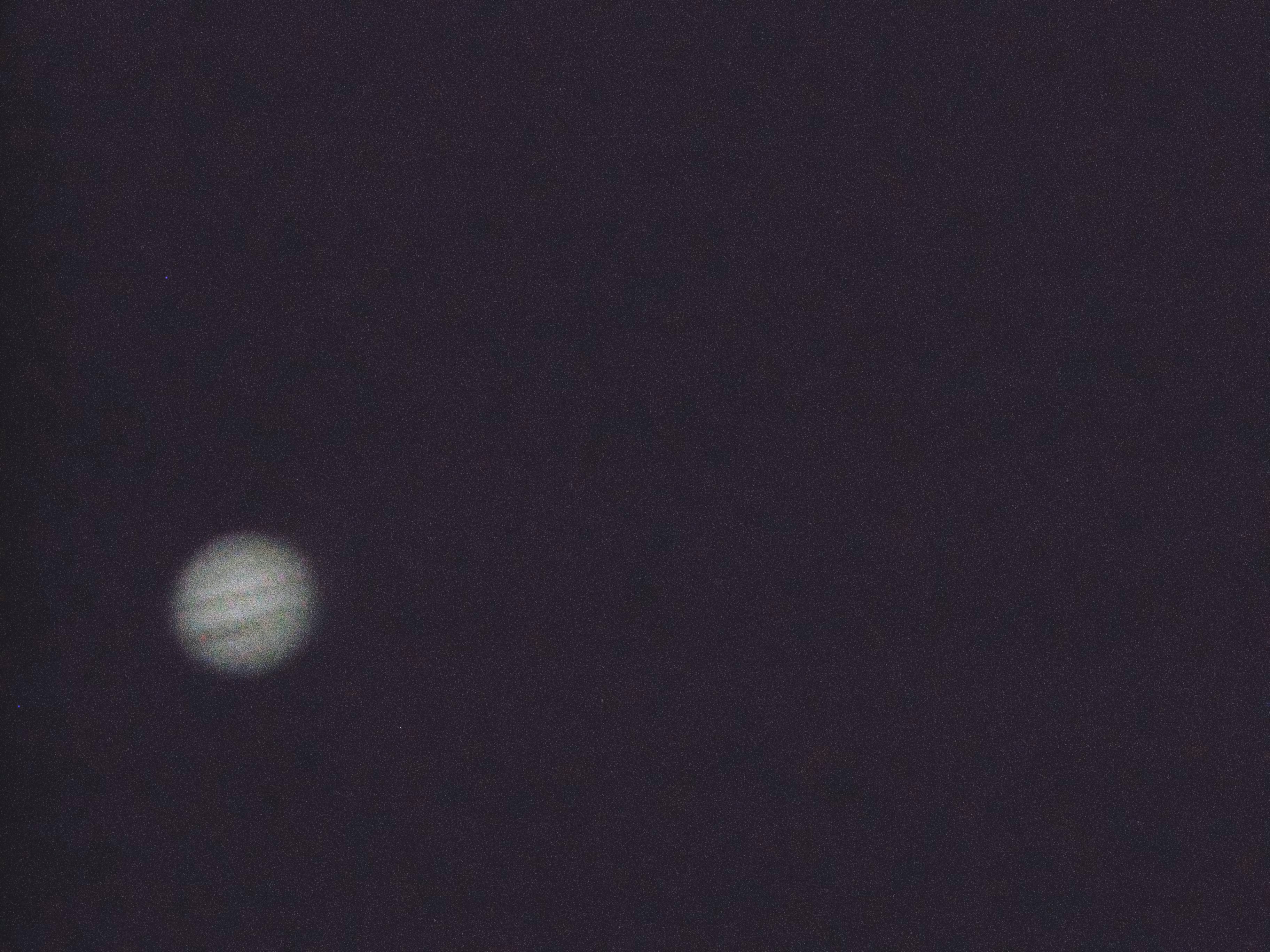
Jupiter from the LX-200
Finally, here an observation of the first quarter Moon through a Mead Newtonian 8 inch with the same camera. If you zoom in on the picture, you might spot the quarter Moon X along the terminator. We made this observations on 1/31/2012.
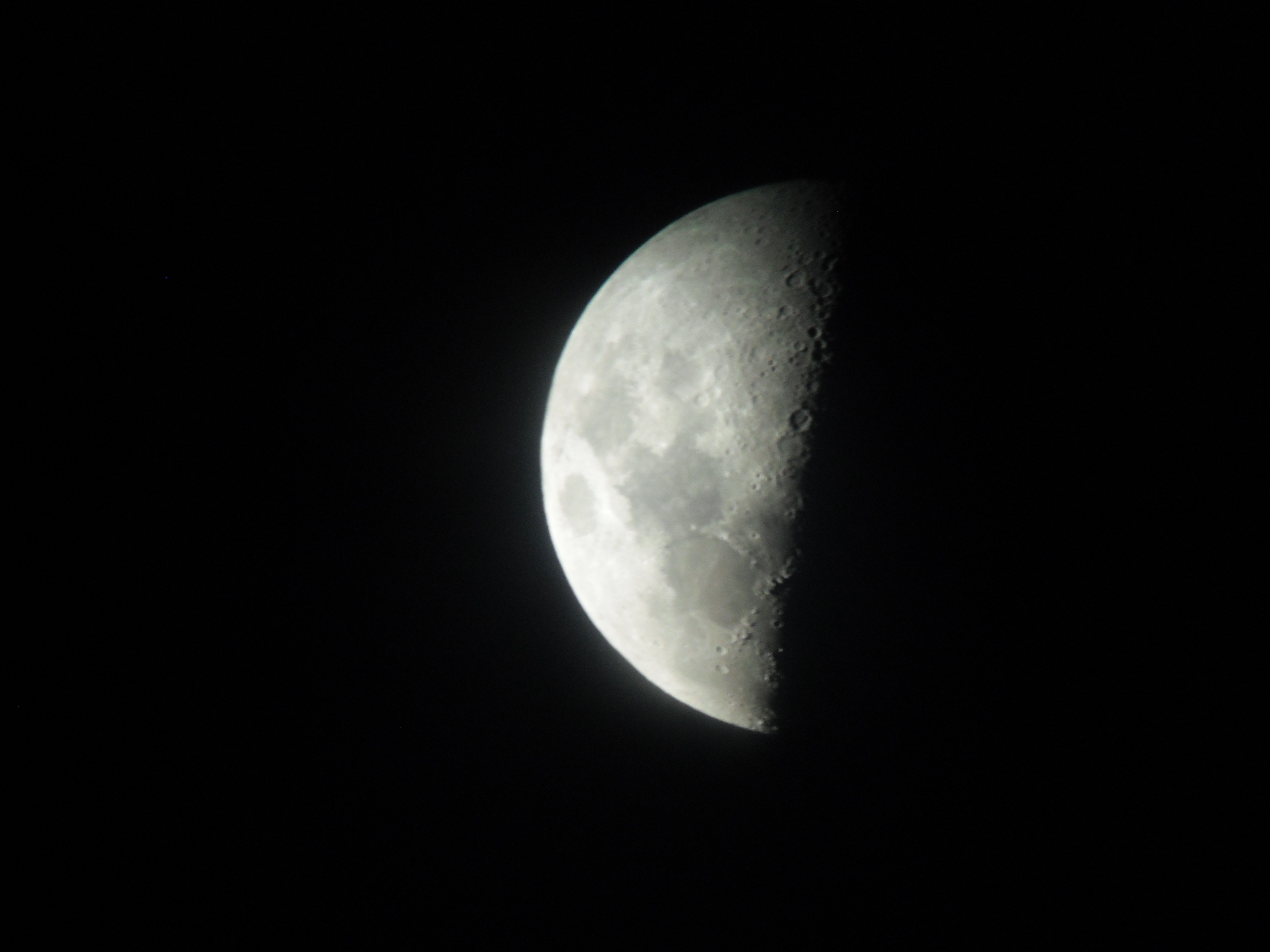
First Quarter Moon the Meade 8 inch.
We had fun and there was much conversation. Look for more material from the next two nights coming up.
Debating the Path
The path to our current understanding of the Universe was not easy or always in the same direction. Sometimes our path would splinter in two (geocentric versus heliocentric); sometimes it would converge (Newton’s Clockwork Universe); and sometimes it would break off in several unending directions (the modern cosmologies). But to construct the path astronomers would have to debate the theories suggested by their observations. The keystone debate for our modern times was the Shapley-Curtis debate of 1920. In the debate, the structure of galaxies was debated. Shapley envisioned a universe of one galaxy, while Curtis envisioned a universe of many galaxies. Which one had the evidence on their side? That is a question you must answer after reviewing the data and their theories.
Mythos and Science
Many stories exist in the annals of Astronomy. They range from being truthful to apocryphal. It also depends on who tells the tale; thus their perspective and analogies. Galileo Galilei was a pious man who tried to guide his church into a new understanding of the Universe. Galileo Galilei was a heretic, philanderer and thus was placed under house arrest for his sins. These two views are vastly different; and the truth is in between these descriptions. But how do we teach this history when different adjectives, emotions become attached to people’s observations? Read this article and judge how we apply scientific methodology to our view of the Universe.
Your Journey’s Beginning
How do you begin a journey? By taking the first step. The first step here is to pick a topic that you will research in depth for the semester. This will aid you in your journey with me during the semester. Find a topic that will challenge you and allow you to understand our discussions. Also encounter one with differing points of view; not already decided by the masses. This topic will be the topic of your final destination, the final project. And explore outside the Solar System as we explore stars, galaxies and our Universe.
What interests you?
Astronomy is a rich science; rich in history, rich in observations, and rich in theories. No wonder you wanted to take the journey with me this semester. This journey is both inside and outside you, as you are made of star stuff. The study of astronomy is the study of your history. Both are intertwined with each other. Now I want to you to look inside your minds eye and tell me what started the journey for you.
Hello!
As a professor of astronomy and physics at Broward College near Ft. Lauderdale, FL, I want an engaged, challenging student. I cherish this chance to shape the next generation of great thinkers. I know it is cliché, but it is a truth that I hold close to my heart. And in this blog I will be covering the different topics relating to Astronomy of the Stars and Galaxies and Horizons in Astronomy. I also hope to get you, the reader, thinking about items talked about in the blog!
 Professor Howard Astronomy Musings
You must be logged in to post a comment.